
Awareness as a strategic asset for leaders
What you don’t know about yourself determines how others perceive you
Following on from my article on fear as a marketing tool, I want to talk about how fear influences not only consumer behaviour but also the decisions of leaders from a psychological perspective.
Leadership is about being aware of your fears.
The Johari window: a navigation map for leaders
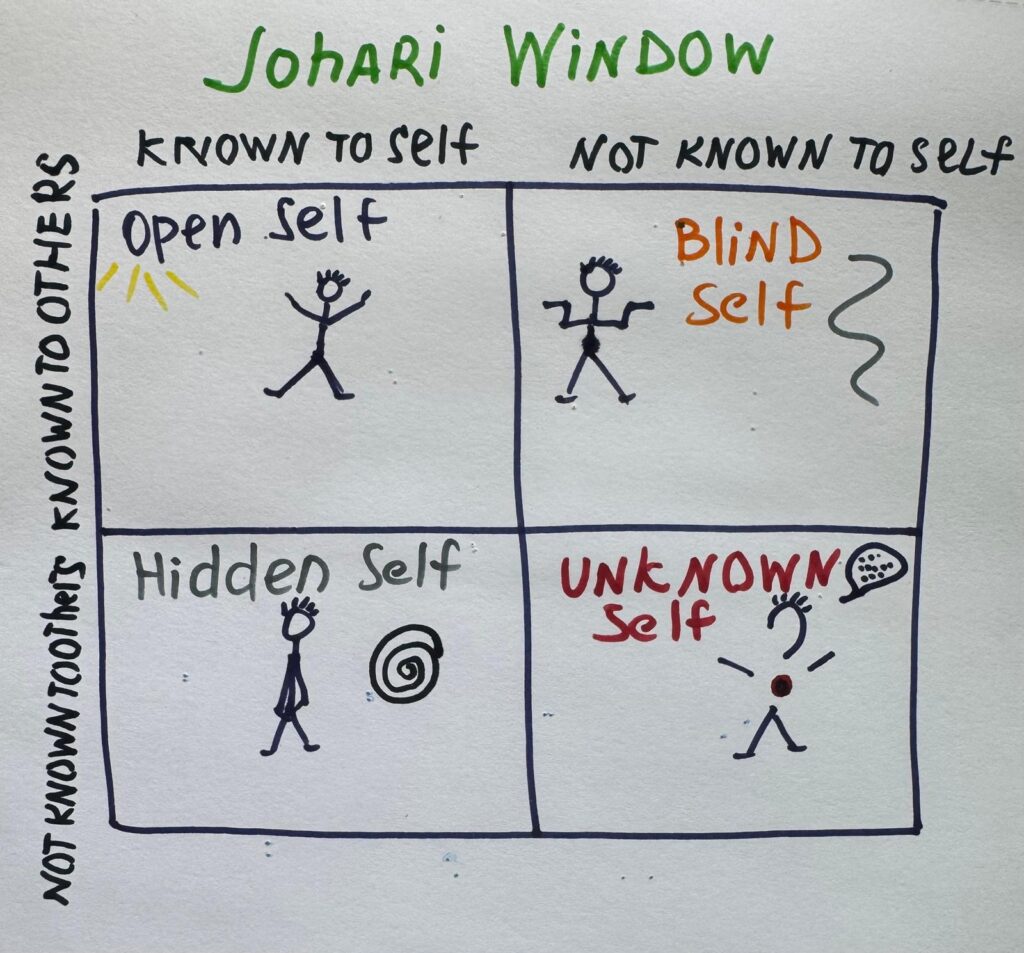
I want to share with you a powerful tool called the Johari Window. It works like a navigation map created by psychotherapists Joseph Luft and Harry Ingham in 1955. It helps understand the relationship between what you know about yourself and what others know about you.
The model consists of four quadrants — your map of self-awareness as a leader.
You are yourself, you are how others see you, and you are the blind spot.
This is cognitive dissonance, where self-esteem and the social mirror collide.
You can defend yourself, or you can change.
Leaders who grow are not those who know everything about themselves, but those who can look at themselves through the eyes of others without excuses.
Johari Window structure
1. Open area (known to me and others)
- Manifested qualities, behaviour, and motives
- Everything we are aware of in ourselves and share with others
- Key: This is where your reputation and the trust of your team lie
2. Blind zone (known to others but not to me)
- Aspects that others notice but we are not aware of
- Danger for the leader: This is where behaviour patterns that undermine your authority are hidden.
- Seeking feedback — you get what you don’t see yourself (BLIND)
3. Hidden area (known to me but hidden from others)
- Personal thoughts, feelings, fears that we do not reveal
- Leadership dilemma: how much should you reveal to your team?
- Self-disclosure — sharing what is hidden (PERSONAL)
4. Unknown zone (unknown to me or others)
- Hidden resources, talents, and unconscious motivations
- The leader’s gold mine: This is where your undiscovered abilities lie
- Explored through self-analysis, therapy, and new experiences
Based on this concept, I came to the following conclusion:
- A leader can control how well they are understood. If they do not share their doubts and values, they remain in the PRIVATE zone.
- If a leader does not ask for the team’s opinion and does not observe their reaction to their decisions, they get stuck in the BLIND state.
- Self-development is managing blind spots.
“Owner’s Manual”: instructions for yourself
You are like a complex device. For people to understand you, they need to know:
- How do you work?
- What makes you tick?
- What is unusual about you?
Questions to ask yourself and those around you:
- What is often misunderstood about you?
- What do you have no patience for?
- How can you be helped?
You cannot manage others if you do not understand yourself.
There is another interesting term in neuroscience: Interpersonal attunement. It is the ability to tune in to others, read their emotional state, and adapt your behaviour.
The “Johari Window” makes this process systematic rather than intuitive:
- You don’t wait for empathy — you learn to interact with yourself
- Self-awareness as a leader = reduced anxiety in the team
The “Johari Window” and the “Owner’s Manual” are your responsibility as an individual.
They work in business and life.
What part of your “Owner’s Manual” are you willing to share with your team?