Burnout: how it develops and how to recover
This guide brings together my series of posts on burnout, in the order I wrote them.
“I thought I was just tired”
That’s what one of my clients told me last week. And honestly? I hear stories like this quite often.
It’s not about weakness. And it’s not about “not being able to cope.”
Burnout is a looooong process. Most important to notice it before your body starts to shut down.
➢ 1974 – Herbert Freudenberger introduced the concept of “burnout” while observing volunteers in a hospital;
➢ 1976 – At the annual conference of the APA (American Psychological Association), the term “emotional burnout syndrome” officially entered the lexicon; to scientific
➢Nowadays – “a phenomenon resulting from chronic stress at work.”
It’s not a diagnosis.
It’s not laziness.
It is not a lack of discipline.
It is a condition that develops gradually.
First, stress appears.
And stress itself is not the enemy.
There is stress that mobilizes us.
It gives us focus, energy, and a sense of the importance of the task we are currently performing.
And there is stress that exceeds our resources.
When there is an inner feeling that the demands exceed the capacity for recovery.
Exceed support.
Exceed sleep.
And then something else begins.
Not “too many emotions,” as with stress.
On the contrary — numbness.
Work begins to seem meaningless — even if objectively everything is fine.
Mornings feel heavy — no matter how much you’ve slept.
Little things that didn’t bother you before are now annoying.
And the thought arises: “Something is wrong with me.”
Burnout has three key signs:
1. Emotional and physical exhaustion
2. Detachment and cynicism towards work
3. Decreased efficiency (you work more but get less done)
And it doesn’t happen overnight.
First comes the stage of enthusiasm — the “honeymoon.”
Then comes the “fuel shortage”: fatigue, forgetfulness, lack of focus, and sleep problems. Sometimes somatic manifestations such as headaches and overeating are added to the mix. And then comes the crisis.
It is important to understand that burnout does not occur solely because of the amount of work.
It is formed at the intersection of:
Ø work demands
Ø personal characteristics (perfectionism, hyper-responsibility, inability to say “no”)
Ø and the presence or absence of resources for recovery and support
When there are many demands and few resources, the system becomes depleted.
This problem requires a systemic solution. Just vacation and meditation don’t help. It’s reality.
Our nervous system needs cycles of relaxation and tension, not a survival mode as a way of life.
In the following posts, we will go deeper:
* How to distinguish stress from burnout
* What stage are you at right now
* a short screening (some tests)
* What really works in prevention
In the meantime, here’s a question:
When was the last time you felt your energy returning, rather than just not decreasing?
Stress or burnout? Why the difference matters
Today I’m continuing my series on burnout — because burnout itself is a gradual process.
The most important thing is to notice it before your body starts to shut down.
Stress or burnout? Why the difference matters
“I’m just overworked” — that’s what most people tell themselves when they feel exhausted and are happy that Friday has arrived.
But what if this condition is not just stress? It’s burnout.
This difference changes everything: what helps, what doesn’t, and how long it takes to recover.
Stress is when there is too much of something.
Burnout is when there is not enough of something.
STRESS ?
* Emotions are heightened (anxiety, urgency)
* Work seems important — perhaps too important
* More activity, rushing
* You feel involved — sometimes to the point of pain
* Recovery, such as a good weekend, can bring you back to normal.
BURNOUT ??️
* Emotions are dulled (numbness, cynicism)
* Work seems meaningless
* More withdrawal, procrastination
* You feel detached
* Even small tasks require disproportionate effort
* Recovery is short-lived: even after rest, the emptiness returns
Here’s how they sound inside:
Stress says, “I have to do everything perfectly!”
Burnout says, “What’s the point?”
Stress is drowning in water.
Burnout is running out of water.
If you ask why it should be important?
Because what helps with stress doesn’t help with burnout.
If you are experiencing stress, time management, delegation, and vacation will help.
If you are experiencing burnout, rest alone is not enough. Your nervous system needs to recover, and you often need to change the structure of your work.
A quick self-check+-+?
1. After the weekend, do I feel recharged — or just temporarily relieved?
2. Are the results of my work still important to me?
3. Am I overwhelmed with emotions or stunned?
Your answers will show you where you are right now.
In the next posts, we will delve deeper into the topic: the values tool and what really helps at each stage.
In the meantime, ask yourself:
Am I drowning in demands? Or have I lost sight of why I am doing this?
Because stress requires recovery.
Burnout requires rebuilding.
Which zone are you in right now?
“I’m fine. Just tired.”
That’s what I used to tell myself, too — until my body forced me to stop for a while.
In my previous posts, we talked about how to distinguish stress from burnout and why it matters.
But the question I hear most often is: “How do I know where I am right now?”
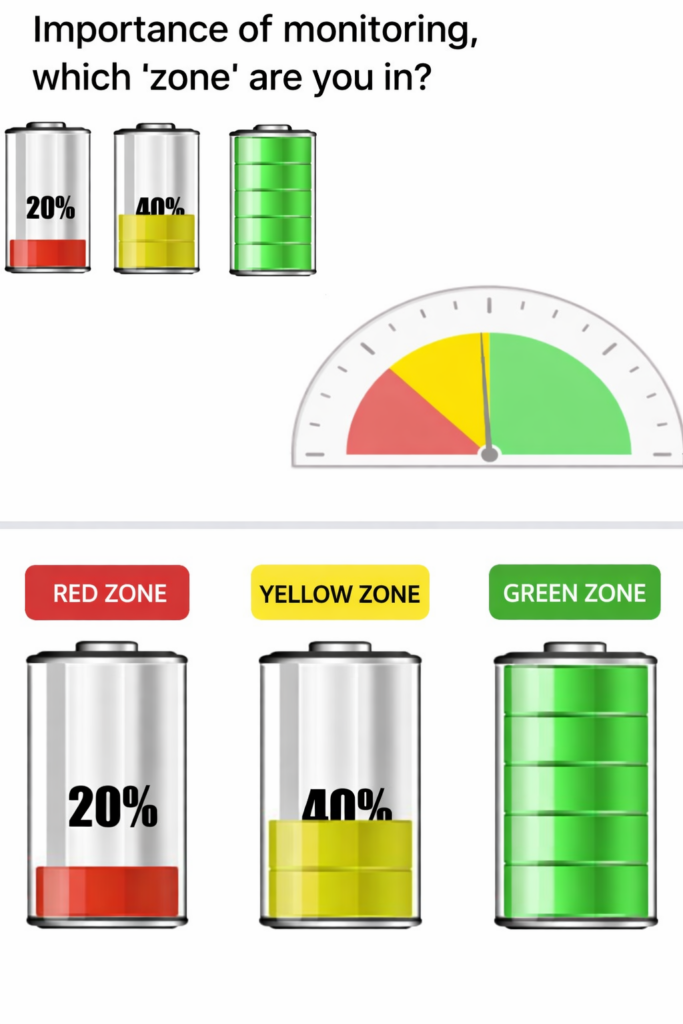
Think of your energy as a battery.
Most people don’t notice they are moving from green to yellow — until they’re already deep in the red.
? GREEN ZONE (100%) — Thriving
· You wake up easily and feel rested
· Work feels meaningful
· finish tasks on time and leave work on time
· You have energy for hobbies, friends, exercise
· You handle conflicts constructively
· You feel present and engaged
YELL ?W ZONE (40%) — Warning signs
· Harder to wake up, need more coffee
· Mood swings, irritability
· Waiting for Friday
· Staying late at work, taking work home
· Skipping lunch or exercise
· Headaches, back pain
· Less time for friends and hobbies
· No feeling of joy
RED Z ? NE (20%) — Burnout territory
· Morning fatigue from the start
· Cynicism, detachment
· Tasks take twice as long
· Many errors, can’t focus
· Working on weekends, all deadlines missed
· Thinking about quitting
· Abandoned exercise and hobbies
· Poor sleep, no desire to see anyone
1. Which zone are you in right now?
2. How long have you been there?
If you’re in the yellow zone, you still have time to course-correct before burnout hits.
If you’re in the red zone, rest alone won’t fix it. You’ll need a structured recovery plan and often changes in how you work.
Before you go, take a moment and write down your own signs for each zone. Knowing your personal markers is the first step to staying out of burnout.
What does your green look like?
What are your yellow warning signs?
What happens when you hit red?
Why is burnout caused by imbalance, not weakness?
Many people believe that burnout occurs because they are not strong enough. Not disciplined enough. Not resilient enough.
Burnout is a problem of imbalance.
It develops when job demands consistently exceed your system’s capacity to recover.
Нow does it work?
In psychology, there’s a model called “job demands-resources”.(JD-R) model proposes that working conditions can be categorized into 2 broad categories: job demands and job resources.
Every job has its demands.
Every person has their own resources.
Burnout begins when demands remain high and resources remain low for too long.
Last week, a client said:
“I can handle the pressure, but I just don’t understand why I feel so drained.”
This is exactly the moment when it would be good to stop and think.
What might high demands look like?
* Chronic overload and deadlines that should have been met yesterday
* Feeling 100% responsible for everything, micromanagement
* Unclear expectations or constantly changing priorities
* Lack of control over your time or decisions
* Constant emotional and cognitive effort without breaks
That’s the demands side.
Now let’s talk about resources.
What might your resources look like?
* For example, autonomy, meaning you have some control over how you work
* A clear structure, possibly a system, and realistic expectations
* When there is real support from colleagues, teamwork, or contact with management
* When you have time to recover, not just to sleep
* When your need for meaning is satisfi,ed and you can clearly see progress, step by step, in what you are doing
* When resources are sufficient, stress can be controlled.
Your nervous system adapts, and in this case, there is an opportunity to grow.
However, when demands remain high and resources remain low, adaptation turns into exhaustion.
This is when you notice:
* Fatigue that does not go away with rest
* Difficulty concentrating
* Irritability or emotional numbness
* When you catch yourself working more but getting less done
Your nervous system is doing exactly what it’s supposed to do when demands exceed resources for too long—it’s trying to protect you.
Some of us are trying to fix this by working even harder. But effort is rarely the missing resource.
Pause for a moment. Take a slow breath in. Exhale longer than you inhaled. Now, could you please answer one question:
** If you could change one thing right now — remove one demand or add one resource — what would it be?
Your answer will tell you where to start.
In my next post, I will share practical tools for restoring balance.
How to restore your resources
In my last post, I wrote about how burnout develops when demands constantly exceed resources. After that, I had one question:
How can you actually restore those resources?
Most people try to recover from burnout the same way they recover from a tough week — by sleeping more, taking time off, or waiting until the weekend. But that doesn’t work.
We think that rest means physical rest. So we sleep, lie on the couch, watch Netflix, or go away for a week to a warm place. And we come back just as exhausted.
Dr. Sandra Dalton-Smith describes seven different types of rest: physical, mental, sensory, creative, emotional, social, and spiritual. Burnout usually means that you have exhausted several of them at once.
Walking helps with physical and mental rest. But it won’t help with the emotional exhaustion of keeping everything under control all day. Or with the social exhaustion of conversations that take more energy than they give. That’s why one solution rarely works.
So what does work?
The stress cycle needs to finish. When pressure lasts for weeks, the body stays in activation mode — even after work is over. A quick walk, stretching, slow breathing with a longer exhale. This signals to the nervous system that the threat has passed. The body needs to complete the cycle it started. Try to find an activity that suits your rhythm.
Small pauses during the day do more than you think. Burnout builds up over months of continuous pressure. Take 3-5 minutes every 90 minutes away from the screen — name all the red things around you, notice 3 sounds, look out the window. These practices bring you back to the present moment. Or go out on the balcony, make yourself a cup of tea. Small breaks throughout the day do more for your nervous system than pushing through until Friday.
Rebuild what sleep can’t restore. Rest restores the body. But burnout also depletes something else — the feeling that your work matters, that someone sees your effort, that you have some control over your day. You can’t sleep your way back from that.
Your brain needs to know the day is over. When burnout sets in, work and rest blur together. A small ritual helps draw that line. Write down what you finished. Close the laptop deliberately. Switch to something that quiets the mind.
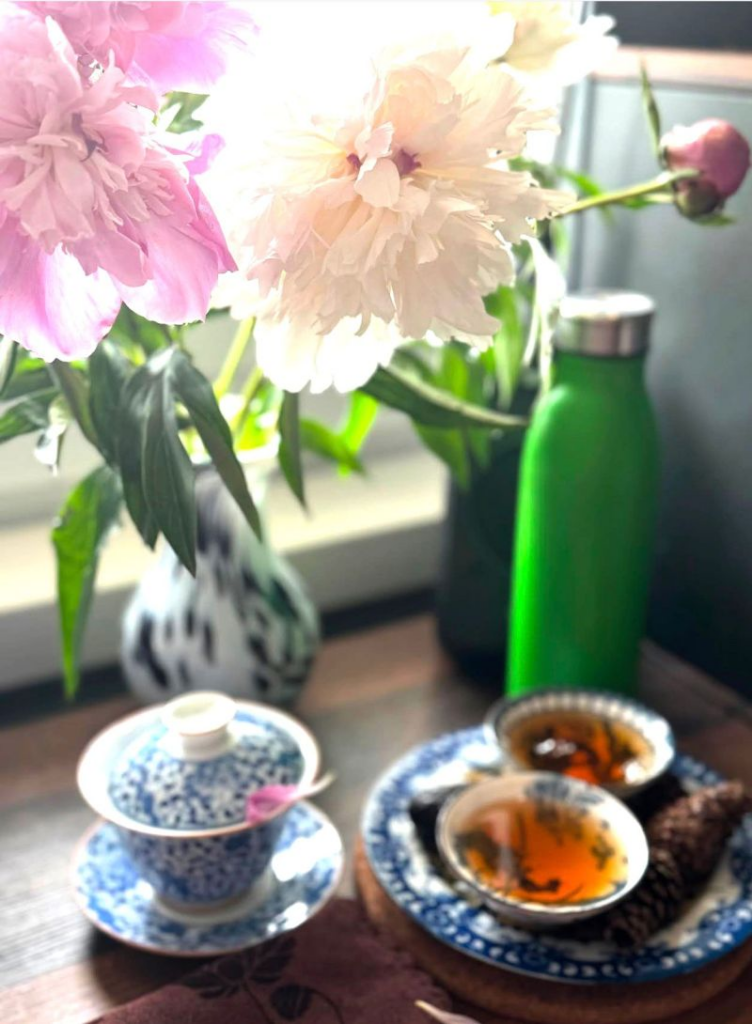
For me, it’s a Chinese tea ceremony. Twenty minutes blocked in my calendar like a meeting — and I’ve been doing it for years. No phone, no screen. Just the process — the warmth of the cup, the smell of the tea. Not because it’s trendy. Because it works. What do you think would work for you?
One more thing — especially if you’re working internationally.
The risk of burnout tends to be higher when you’re working in a second or third language and navigating a new culture. The nervous system invests energy even before the workday starts. Without intentional recovery, that gradually turns into exhaustion — and it’s easy to miss because it feels like it’s just part of the adjustment.
What can you realistically fit into your day?
Recovery starts with one small signal of safety — given to yourself consistently enough that your body actually starts to believe it.
Next: the energy leaks you probably don’t notice — perfectionism, excessive responsibility, and the belief that working harder will eventually solve everything. Spoiler: it won’t.
But that’s for next time, right now I’m going to make myself some tea.

Sources of energy drain that you probably don’t notice
In my last post, I promised to talk about perfectionism, an excessive sense of responsibility, and the belief that if you work harder, all your problems will eventually be solved.
In stress research, there is a concept called a “stress amplifier”—a deeply ingrained belief that quietly turns everyday stress into exhaustion.
Most of us have at least one such “amplifier.” Many have two or three.
And this is often where burnout begins—not with the workload itself, but with the beliefs that won’t let you stop.
There are five main ones:
? “I have to do everything perfectly.” The fear of failure or mistakes forces you to constantly overdo things—even when no one asks you to.
☺️ “I need everyone to like me.” Saying “no” feels dangerous. Disappointing someone feels unbearable. So you keep saying “yes”—until there’s nothing left.
? “I have to handle everything on my own.” Asking for help feels like a weakness. So you carry everything on your shoulders and wonder why you’re so tired.
? “I have to control everything.” Uncertainty is unbearable. So you expend enormous energy trying to control what cannot be controlled.
? “I must keep going, no matter what.” Rest feels like failure. Stopping feels like weakness and vulnerability. So you keep going—ignoring all the signals your body is sending.
None of these beliefs is random. Each one protects something real—the need for safety, connection, autonomy, or self-worth.
The thing is, when beliefs run on autopilot, they become fertile ground for burnout. Not the workload. Not complicated relationships with your boss or colleagues. Not deadlines or KPIs.
The belief underlying all of this.
I’ve put together 25 statements that will take about 3 minutes to fill out and will clearly show you where your energy is going.
If you’re interested, write “check list” in the comments, and I’ll send it to you directly. Once you’ve marked your answers, I can analyze your profile for you.
Which of these do you recognize in yourself?
Your body doesn’t know the meeting is over
From 1987 to 1991, in the Arizona desert, scientists built a sealed ecosystem called Biosphere 2 — 1.27 hectares of closed space, designed to test whether humans could survive in complete isolation. A prototype for future space colonization.
The trees had everything: water, light, perfect soil, stable temperature.
But after a while, their trunks started snapping.
The reason? No wind.
In nature, trees are constantly bent and pushed. That pressure is what builds a strong trunk. Without it, the structure stays fragile.
Remove the wind. The tree breaks.
The same thing happens with stress.
Our bodys is designed to complete a full cycle.
Threat appears → system activates → you act → threat passes → system resets.
It’s that last step most of us skip.
The meeting ends. The deadline passes. The difficult conversation is over.
But the body? Still running. Still in it.
Our heart rate stays elevated, muscles remain tense, and cortisol continues circulating in the bloodstream.
We close the laptop and wonder why we can’t switch off.
This isn’t a lack of willpower. It’s an incomplete cycle.
The stress response was never meant to stop. It needs to finish. And finishing it is physical, not mental. You can’t think your way out of it.
Small actions help:
→ Movement. A walk, stretching, anything that uses the body. Even 10 minutes.
→ Breath. Longer exhale than inhale. This directly signals the nervous system: threat has passed.
→ Physical contact. A hug, a handshake. Real and tangible.
→ A short ritual that marks the end of work. Not scrolling. Something deliberate.
For me, it’s a tea ceremony. Twenty minutes. No phone. Take a moment enjoying the process — the warmth of the cup, the smell, the repetition. It tells my body: we’re done for today.
Recovery doesn’t have to be complicated. It starts with small, repeated signals that the nervous system can recognize and trust.
What do you do to truly end the day — not just stop working?
Burnout isn’t one big breakdown. It’s hundreds of cycles that never closed — accumulated over months.
My next post is about: Why your thoughts are not always telling you the truth.